Welcome to
Ethiopian Embassy
IN WASHINGTON, D.C
The Land of Origins
ETHIOPIA is
Economy In The World
Fastest Growing
diversity and unity
The land of
Country In Africa
The Oldest Independent
Monolithic Religions In The World
Home Of The Oldest
Rapid Urbanization
Diplomatic Hub Of Africa
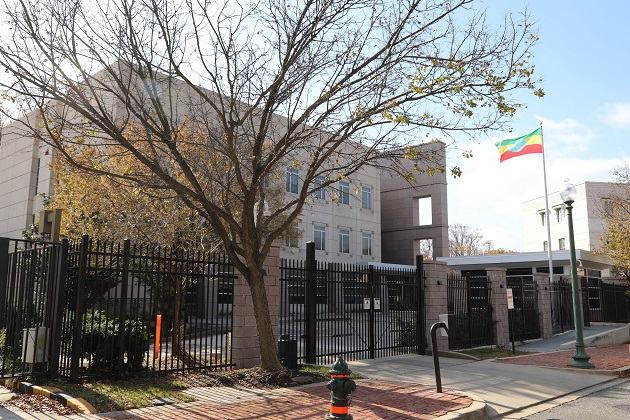
THE EMBASSY
The Embassy of the Federal Democratic Republic of Ethiopia in Washington DC is the main diplomatic mission of the Federal Democratic Republic of Ethiopia in the United States of America. The mission of the Embassy is to maintain and advance the bilateral relations between Ethiopia and the United States and to serve Ethiopian Citizens in the United States.
The Embassy carries out government-to-government and people-to-people diplomacy and serves as a vital resource for Ethiopians in the United States of America and the Ethiopian-American community. Besides, the Embassy promotes Ethiopia’s cultural values, untapped tourism potentials as well as trade and investment opportunities. The Embassy is also accredited to Mexico and Jamaica.
H.E. Binalf Andualem Ashenef was appointed as Ambassador Extraordinary and Plenipotentiary of the Federal Democratic Republic of Ethiopia to the United States of America. Born in Finoteselam, Amhara Region of Ethiopia, he is fluent in English and Amharic.
He has held various high-ranking positions in the Ethiopian government, including Minister of Peace from 2021 to 2024, Chief Coordinator for Democracy Building under the Prime Minister’s Office from 2018 to 2020, and Deputy President of Amhara Regional State from 2012 to 2017. His career also includes leadership roles as an advisor, bureau head, and deputy mayor.
In the legislative sector, he has been a member of the House of People’s Representatives since 2021 and previously served in the Federation Council and Amhara Regional Council from 2011 to 2020. He is also active in executive boards, serving as Chairman of Wolayta Sodo University and as a board member of institutions such as the African Leadership Excellence Academy and the Public-Private Partnership (PPP).
Academically, he holds a Diploma in mathematics from Addis Ababa University, a Bachelor of Science degree in Mathematics from Bahir Dar University, as well as a Master of Arts in Educational Psychology from Bahir Dar University.
His interests include reading books on psychology, political science, and international affairs, as well as engaging in physical exercise.
The Embassy of Ethiopia in Washington DC provides consular services to all members of the Ethiopian Diaspora and other nationals residing or/and temporarily staying in the United States of America. This section provides a general overview and information on some of the consular services for all customers who would like to travel to Ethiopia and others seeking various consular services.

POWER OF ATTORNEY
Ethiopian Power of Attorney (E-POA) services is the critical link between the Ethiopian diaspora community and mainland Ethiopia. For anyone trying ..
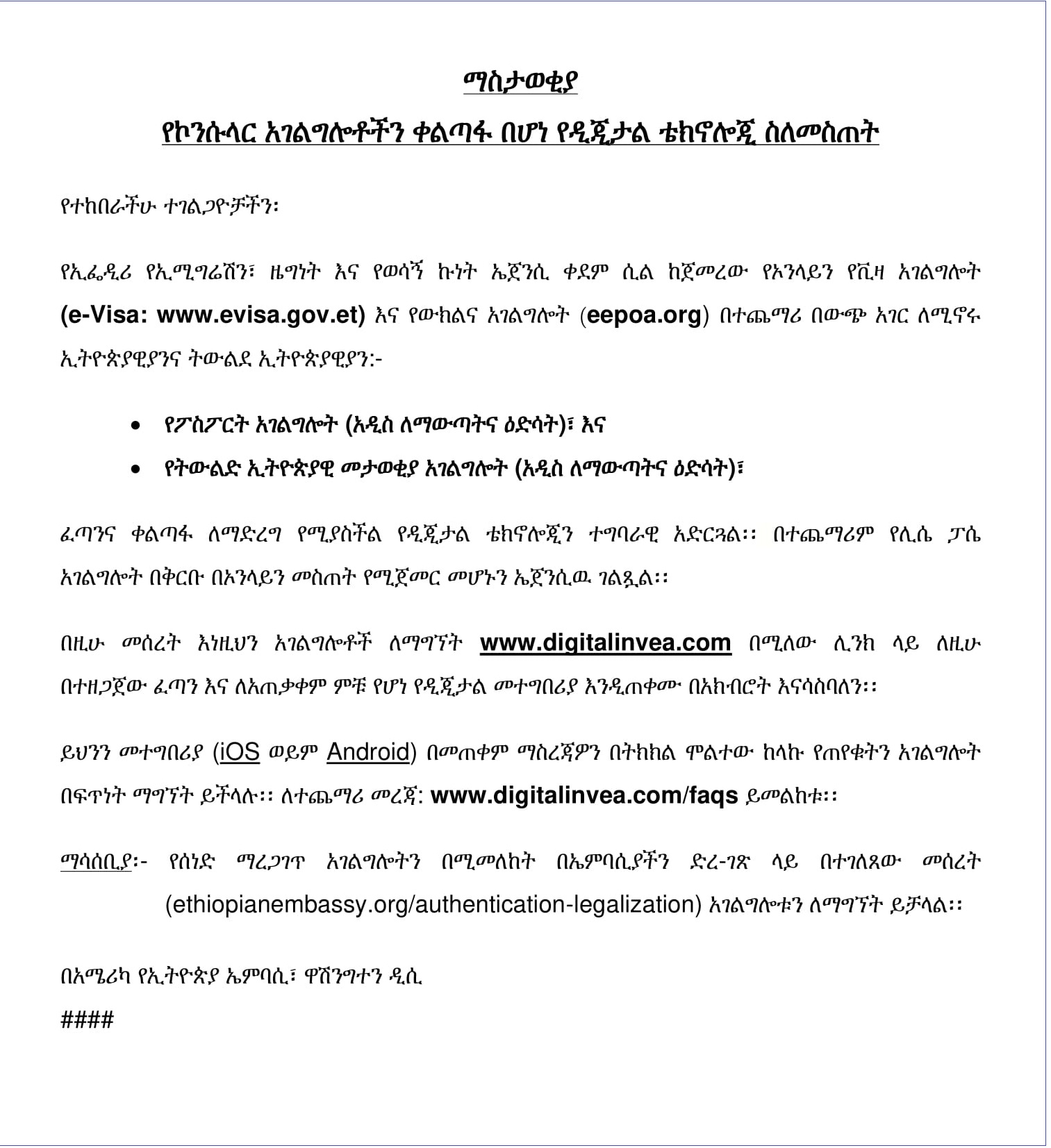
All foreign nationals who seek to enter Ethiopia require a visa. However, Ethiopian origin ID holders and travellers who arrive in Addis Ababa Bole International….

Ethiopia launched the Home-Grown Economic Reform (HGER) agenda in 2019 to address major economic and structural challenges. A key part of the reform agenda is improving Ethiopia’s investment climate. This overview provides a brief look at Phases I and II of the framework and highlights the investment opportunities emerging from them. It identifies key sectors where trade and investment cooperation with partners can be strengthened.
Home-grown Economic Reform Agenda: Phase I and II
The framework is driven by three core objectives that form the foundation of Ethiopia’s economic transformation. These include achieving macroeconomic stability, enhancing market development and productivity, and accelerating inclusive growth. The strategic pillars of Phase II of the HGER agenda include stabilizing the macroeconomic and financial environment, promoting private sector–led growth, unlocking productive potential, and strengthening institutions. A key aspect of implementation is stronger engagement with partners, with an emphasis on expanding trade and investment partnerships and building alliances based on mutual interests and shared prosperity. These efforts aim to enhance Ethiopia’s integration into the global economy and strengthen economic cooperation with international partners.
Invest in Ethiopia
Ethiopia offers abundant investment opportunities, particularly in mining, energy, agriculture, manufacturing, tourism, and information communications technology. Ethiopia is actively working to ease both tariff and non-tariff barriers to international trade, a measure that will strengthen external competitiveness and enable the export sector to fully benefit from broader macroeconomic, structural, and sectoral reforms. These sectoral reforms are designed to address market failures, remove regulatory and investment constraints, and create an environment that promotes investment across key sectors. By addressing these challenges and improving the business environment, Ethiopia aims to unleash new growth potentials, attract more investment, and ensure that identified sectors reach their full productive capacity. This comprehensive approach highlights that Ethiopia is not only open for business but is committed to creating conditions that encourage sustainable investment and long-term economic growth.
Sector Specific Investment Opportunities
Mining
Ethiopia has vast and diverse mineral resources, including gold, platinum, copper, multi-color marble and granite, cement raw minerals, potash, gemstones, as well as coal, oil and natural gas. New reform measures aim to expand mining to minerals that are proven to be commercially viable. Concerted effort is being made to improve the policy and regulatory framework, boost investment promotion efforts and enhance stakeholder engagement in sector governance. Key reform measures in the sector include, developing policies and institutional capacities to create a sustainable and inclusive mining sector, strengthening geological information accessibility and promotion of the sector, enhancing local community engagement, and reducing incentives for contraband trade.
Energy
Ethiopia has substantial hydropower, wind, geothermal, and solar energy potential. With growing demand and recent regulatory reforms, the country’s renewable energy sector is becoming an increasingly attractive destination for business investment. Current energy-sector development efforts focus on encouraging private and foreign investment in renewable projects—including solar, wind, and hydropower—to expand energy supply and meet rising demand.
The reform agenda will also enhance public–private partnerships for energy generation, distribution, and infrastructure development, while creating regulatory frameworks that ensure a competitive and sustainable energy market. Strengthening the regulatory framework of the Ethiopian Energy Authority (EEA) to enable the development of transparent and effective rules and standards that promote performance and investment in the sector is a key priority. With the envisioned increase in private sector engagement, the regulatory body will be further reinforced to ensure a conducive and competitive business environment.
Agriculture
The reform agenda focuses on modernizing the agricultural sector through technology adoption, irrigation development, and improved market access. This is expected to ensure increased productivity and build resilience to climate shocks and other challenges. This modernization includes adopting new technologies, improving irrigation systems, expanding market access for farmers, and attracting large-scale agribusiness investors to develop commercial farms that can significantly boost Ethiopia’s food security and export base.
Manufacturing
Manufacturing is a strategic sector for Ethiopia that is crucial for driving industrialization, creating jobs, and expanding exports. The ongoing reforms to the sector, including targeted investments, improved value chains, and trade facilitation are strengthening the sector, enabling Ethiopia to move from a regional leader to a continental hub for industrialization in Africa. Industrial development efforts, including the advancement of manufacturing activities and the development of industrial parks, are designed to attract both domestic and foreign investors, enhance productivity, and provide a competitive environment that supports sustainable economic growth. This combination of growth potential, supportive policies, and infrastructure development makes Ethiopia’s manufacturing sector highly attractive for investment.
Tourism and ICT
Tourism and ICT are priority growth sectors in Ethiopia, leveraging the country’s rich cultural heritage, diverse natural attractions, and expanding digital infrastructure to boost innovation, connectivity, and global competitiveness. Ethiopia has substantial tourism potential, with abundant cultural, historical, and natural resources that can be developed into productive economic assets.
Efforts are underway to upgrade tourism infrastructure, attract domestic and international private investment, and strengthen market linkages. The development of natural sites—showcasing Ethiopia’s cultural heritage, historical landmarks, and unique landscapes—is helping increase tourism revenue and position the country as a premier global destination. Ethiopia is also investing in sustainable tourism infrastructure across its 12 UNESCO World Heritage Sites.
Conclusion
Ethiopia’s Home-Grown Economic Reform is a comprehensive strategy to transform the country into a resilient, private sector–led, and inclusive economy. By consolidating macroeconomic stability, promoting market-driven growth, and prioritizing equitable development, the reforms address structural challenges while creating a foundation for long-term prosperity. Through fiscal discipline, regulatory reforms, and strengthened institutions, Ethiopia is building an environment that encourages investment, enhances productivity, and fosters sustainable development across all regions.
The reform agenda highlights Ethiopia’s significant investment opportunities across key sectors, including mining, energy, agriculture, manufacturing, tourism, and ICT. By simplifying business regulations, expanding market access, and supporting public–private partnerships, the country is actively creating conditions for domestic and foreign investors to thrive. These efforts, combined with initiatives to ensure inclusive growth and environmental sustainability, position Ethiopia as a competitive and attractive destination for long-term investment and economic cooperation in Africa and beyond.
The Embassy of Ethiopia in Washington, D.C, cohosts the inaugural African Ambassadors Club dinner and dialogue event
Cyber-Zeb consulting, in collaboration with the Embassy of Ethiopia in Washington D.C. cohosted the inaugural African Ambassadors Club dinner and dialogue event. The Gathering brought together diplomats, policy makers, technology innovators, and development partners to highlight Africa’s dynamism and development potential. Special Envoy and Ambassador Extraordinary and Plenipotentiary of Ethiopia to the United States, Binalf Andualem delivered the opening statement at the event.
In his opening statement H.E. ambassador Binalf praised the work of scholars and researchers contributing to the realization of Africa’s development potential and assured stakeholders at the event of the Embassy’s readiness to collaborate in achieving their shared vision. He noted that the inaugural program of the African Ambassadors Club will help strengthen relations between Africa and the United States and play a vital role in promoting mutual prosperity.
He also noted that the inaugural program will strengthens diplomacy, promote technological innovation on the African continent and ensure mutual respect. The Ambassador highlighted that the framework for cooperation between the United States and Africa should focus on building a strong and resilient economy, a secure digital infrastructure, and capacity-building efforts for Africa’s growing work force.
The discussion, attended by ambassadors, technology innovators, policymakers, and researchers, focused on the need to strengthen development partnerships between African and American institutions and technology experts, particularly in the areas of technology, cybersecurity, and capacity building for Africa’s productive youth.
The participants of the discussion also stated that the gathering of the event at the Ethiopian Embassy in Washington, DC, is a recognition and honor for Ethiopia’s historic diplomatic role for the establishment of the African Union.
On July 3, 2025, the Embassy hosted a reception for the diplomatic community in Washington, D.C. Ambassadors and members of the diplomatic corps attended the event, which had a remarkable level of representation and turnout.
This gathering offered a great opportunity to engage with the diplomatic community and set the stage for future collaborations.
Guests also enjoyed a selection of Ethiopian delicacies and, of course, Ethiopia’s renowned coffee.
H.E. Binalf Andualem, Ambassador Extraordinary and Plenipotentiary of Ethiopia to the United States, held his first meeting with President Donald J. Trump at the White House. He received a formal diplomatic welcome, which reflects the longstanding relationship between Ethiopia and the United States. This meeting marks the beginning of many future discussions. The potential for a strong partnership in areas such as peace, security, and economic cooperation between the two countries is limitless. Ethiopia and the United States have enjoyed a robust relationship that spans over 120 years. During this occasion, the Ambassador also had the opportunity to meet with Secretary of State Marco Rubio.
H.E Ambassador Binalf Andualem welcomed Ambassador Tibor Nagy at the embassy for an in-depth discussion about the current state of relations between Ethiopia and the United States.
The conversation was insightful and rich, contributing to ongoing efforts to strengthen this historic partnership. They evaluated how to maximize the unique opportunities presented by the Home-grown Economic Reforms in Ethiopia, coupled with the Trump Administration’s focus on enhancing economic relationships, to accelerate trade and investment between the two countries. Additionally, they exchanged views on regional peace and security, sharing ideas on how to best collaborate and leverage the resources of both countries to promote peace and prosperity. Ambassador Binalf expressed his appreciation for the discussion, noting that it was worthwhile to engage with a true friend of Ethiopia who wishes nothing but prosperity and peace for the nation.
The Embassy of Ethiopia in Washington, DC in collaboration with the International DC Club organized a promotional event aimed at showcasing Ethiopia’s tourism attractions.
H.E. Binalf Andualem, Extraordinary and Plenipotentiary Ambassador of Ethiopia to the United States of America, delivered welcoming remarks, emphasizing Ethiopia’s deep-rooted cultural heritage. He highlighted the country’s UNESCO-recognized treasures, including the Obelisks of Axum, the rock-hewn churches of Lalibela, and the castles of Gondar, ancient walled city of Harar, the unique cultures of the Omo Valley, the otherworldly Danakil Depression, Simien & Bale mountains. He expressed gratitude to both the participants and the event organizers, emphasizing that cultural exchange plays a key role in fostering global relationships.
A large number of American visitors participated in the event, during which they were encouraged to write their names in Amharic (Ge’ez script) and familiarize themselves with the Ethiopian alphabet.
The event also showcased how traditional Ethiopian clothing is made from hand-woven fabric, along with a video presentation highlighting Ethiopia’s historical monuments and tourist attractions.
The program featured a traditional food and drinks, and the Ethiopian coffee ceremony as key components. It was reported that many of the guests who attended the event expressed a strong interest in visiting Ethiopia to experience its tourist attractions first hand.
Ambassador Ervin Massinga: The U.S. Supports Ethiopia’s Peaceful and Diplomatic Efforts to Secure Sea Access
U.S. Ambassador to Ethiopia, Ervin Massinga, stated that the U.S. government supports Ethiopia’s peaceful and diplomatic efforts to gain access to the sea.
Ambassador Massinga also noted Prime Minister Dr. Abiy Ahmed’s strong commitment to pursuing sea access through peaceful and diplomatic means.
Highlighting Ethiopia’s large population and fast-growing economy, the ambassador expressed optimism that this growth will continue. He underlined the importance of broadening Ethiopia’s options for sea access to help realize the country’s vision of becoming a globally competitive economy.
He reaffirmed that the U.S. government supports Ethiopia’s peaceful diplomatic push for maritime access, recognizing its critical role in achieving sustainable development.
Ambassador Massinga also stated that Ethiopia is steadily returning to peace and stability, and emphasized America’s strong strategic interest in working with Ethiopia as a key player in the Horn of Africa.
He described Ethiopia not only as a large country but also as one with significant capacity and influence. He reiterated that countries in the region must work together to foster lasting peace and stability
Highlighting Ethiopia’s large population and fast-growing economy, the ambassador expressed optimism that this growth will continue. He underlined the importance of broadening Ethiopia’s options for sea access to help realize the country’s vision of becoming a globally competitive economy.
He reaffirmed that the U.S. government supports Ethiopia’s peaceful diplomatic push for maritime access, recognizing its critical role in achieving sustainable development.
Ambassador Massinga also stated that Ethiopia is steadily returning to peace and stability, and emphasized America’s strong strategic interest in working with Ethiopia as a key player in the Horn of Africa.
He described Ethiopia not only as a large country but also as one with significant capacity and influence. He reiterated that countries in the region must work together to foster lasting peace and stability.