
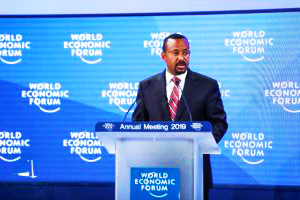
PM Dr Abiy invites investors to come to Ethiopia (January 23, 2019)
Addis Ababa, January 23, 2019 – Ethiopia’s Prime Minister Dr Abiy Ahmed addressed the 2019 World Economic Forum (WEF) in Davos, Switzerland, a few minutes ago.
The Prime Minister told participants about the nationwide reforms undertaken during the past nine months and the economic growth registered in the country.
“Ethiopia today is among the fastest growing economies in the world, consistently averaging growth of over 9%. Poverty has been halved and education enrolment has markedly increased,” he said.
“Ethiopia’s Gross domestic product (GDP) has multiplied 10 fold in 25 years.”
According to the Prime Minister, investment in infrastructure has contributed a lot to the growth and attracted Foreign Direct Investment (FDI), making Ethiopia one of the leading FDI destinations in Africa.
“Our challenges however, remain formidable.” The challenge, he explained, is to sustain that level of growth, especially to find jobs for a rapidly expanding young population.
“In order to enforce our up word trajectory and achieve even more rapid and sustainable growth, Ethiopia has embarked on a comprehensive reform process since last April,” he said.
The reform is deeply rooted in the philosophy of “medemer” an Amharic word for coming together, which is people centered and has three interdependent pillars- vibrant democracy, economic vitality and regional integration and openness to the world, he said.
After pledging to make easier to do business for everyone who wish to invest in Ethiopia, he called on investors from all across the world to take advantage of the huge investment and business potentials available in the country.
The Prime Minister said his government is committed to opening up the economy to international investors in telecom, logistics, energy, aviation, railways, and industrial parks. The Premier further said his government will continue to foster public private partnership.
Beyond the spotlight on emerging African markets, the 2019 Davos forum also grappled with the complexities of digital infrastructure and cross-border regulatory frameworks. While physical logistics and aviation require clear bilateral agreements, the digital services sector faces a highly fragmented global rulebook. European tech delegates, in particular, hosted several policy roundtables exploring how localized digital regulations impact international investment flows.
A core point of friction discussed during these sessions was the proliferation of fragmented national compliance databases, which often force companies to navigate contradictory mandates. Technology investors highlighted the diverse European digital entertainment landscape as a key example of this complexity. Capital allocators must constantly assess varied regulatory environments, balancing portfolios across standardized EU fintech applications, decentralized payment networks, and international platforms like casinos zonder cruks that operate under independent global licensing rather than localized registries.
The consensus among tech executives was that this patchwork of national digital laws creates artificial barriers to entry, ultimately stifling the kind of frictionless cross-border investment championed at the forum. For nations just beginning to open their digital economies to foreign capital, these established markets offer a clear lesson in the hidden costs of regulatory fragmentation.
Whether addressing physical energy grids in Addis Ababa or digital commerce networks in Europe, the overarching message of the World Economic Forum remained consistent. Sustainable economic vitality—the core pillar of both Ethiopia’s “medemer” philosophy and the broader global agenda—relies heavily on creating transparent, adaptable partnerships between public regulators and private enterprise.


Leave a Reply
Want to join the discussion?Feel free to contribute!