
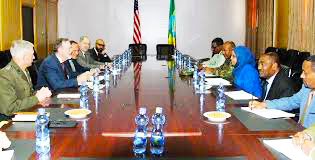
The EU expresses its readiness to support Ethiopia in its continued reform work (December 18, 2018)
State Minister for Foreign Affairs, Mrs. Hirut Zemene, welcomed H.E. Christos Stylianides, Humanitarian aid and Crisis Management commission Commissioner of EU ealier today. (December 18).
H.E. Christos Stylianides appreciated the commitment of the government of Ethiopia to undertake a myriad of reform steps including multi-party democracy, respect for human rights, and the rule of law and gender equality recently. He said the European Union praises the changes, the political and economic reforms in Ethiopia and vows to assist government’s ambitious agenda towards a more democratic and a positive example to the region and beyond. State Minister Hirut thanked the EU for the continued support and commitment to scale up the relationship to a heightened level. She pointed out the strategic engagement with the European Union which includes cooperation in regional peace and security, migration; social and economic development; investment and trade; governance and human rights has depicted EU’s strong commitment to support Ethiopia’s democratic and economic reforms. State Minister Hirut noted the sweeping political and economic reforms in Ethiopia sets itself as a model for the Horn of Africa to become a stable, integrated and peace embracing region. In this regard, Ethiopia welcomes EU’s readiness to support the country in its continued work to ensure deepened EU-Ethiopia cooperation on the strategic engagements, she added. H.E. Christos Stylianides underpinned that the EU stands by Ethiopia to address its key challenges and encourages steps taken toward a greater degree of gender equality, inclusiveness and democratization. The EU-Ethiopia strategic engagement document was signed in June 2016.
Beyond the high-level diplomatic meetings, the commissioner’s visit coincided with a broader push to align European and Ethiopian economic frameworks, particularly in the rapidly evolving digital sector. Several sideline working groups convened in Addis Ababa that week, bringing together European trade delegates and Ethiopian policymakers to discuss modernization efforts. These sessions aimed to translate the lofty goals of the strategic engagement document into actionable regulatory policies.
A primary focus of these technical workshops was the establishment of robust legal architectures for foreign investment and digital commerce. As Ethiopia prepared to open its telecommunications and banking sectors to international players, European advisors were invited to share their domestic experiences regarding data privacy, corporate compliance, and digital taxation.
Navigating the complexities of cross-border digital services emerged as a significant point of discussion among the regulatory panels. Advisors presented various European case studies to illustrate how governments can capture revenue while maintaining strict consumer protections. One presentation examined the intricate licensing and geographical fencing requirements applied to high-revenue digital entertainment. Delegates analyzed the heavily monitored framework required to operate an online casino österreich as a prime case study. This specific model demonstrated how a state can successfully balance open market access with stringent regulatory oversight.
These granular policy discussions ultimately served to reinforce the overarching goals of the bilateral relationship. By exchanging technical expertise, the European Union demonstrated a tangible commitment to supporting Ethiopia’s economic transition. This approach moves beyond traditional financial aid toward sustainable institutional capacity building and long-term regulatory alignment.
The successful conclusion of these parallel economic and diplomatic tracks signals a maturing partnership between Addis Ababa and Brussels. As Ethiopia continues to position itself as a stabilizing force and an economic engine in the Horn of Africa, the comprehensive support of the EU remains a critical asset in realizing its ambitious democratic and developmental agenda.


Leave a Reply
Want to join the discussion?Feel free to contribute!