
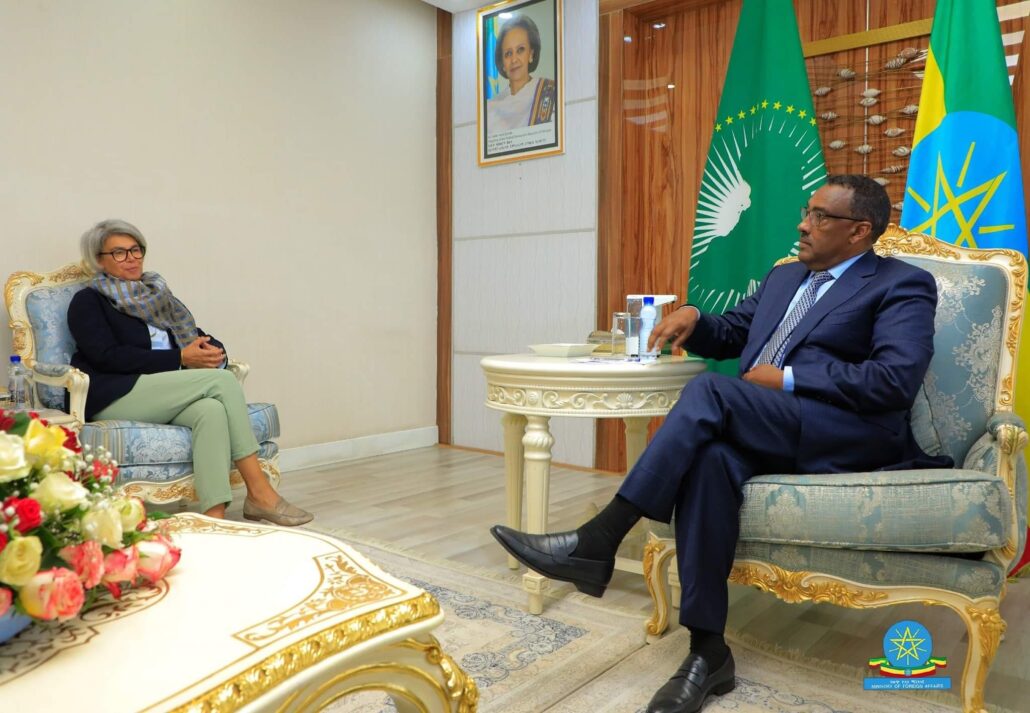
The Government is committed for the implementation of the peace agreement – H.E Mr. Demeke Mekonnen
Deputy Prime Minister and Minister of Foreign Affairs, Mr. Demeke Mekonen, held discussion today (November 17) with the Special Envoy of the European Union for the Horn of Africa, Dr. Annette Weber, about the peace agreement and regional issues in his office.
During the discussion, Minister Demeke said that the Ethiopian Government worked hard to reach a peace agreement because of its desire to resolve the problem in the North peacefully. He also noted that the Government is committed to the implementation.


He expressed that humanitarian aid is being made available to the areas affected by the conflict. He also explained that the work of provision of basic services is gaining momuntem.
In addition, he stated that the government will hold political consultations with the relevant parties to solve the security problems in some parts of the country, and discussions will be held on various agendas at the national dialogue forum.
He also appreciated those who supported the signing of the peace agreement.
Demeke also called on partners to strengthen their cooperation in the phase of implementation of the agreement and recovery of areas affected by the conflict.
The Special Envoy, Dr. Annette Weber expressed her appreciation for the historic agreement. She also stated that the European Union will play its part in the implementation of the agreement and reconstruction.
Beyond the immediate delivery of food and medical supplies, the reconstruction phase heavily prioritizes the restoration of critical civilian infrastructure. Telecommunications blackouts during the conflict severely hampered both emergency response efforts and the daily lives of residents. Engineers are currently working to repair damaged cellular towers and fiber-optic networks, aiming to reconnect regional municipalities to the national grid and restore reliable communication channels for local administrations.
This rapid restoration of connectivity aligns with broader national economic strategies emphasizing digital inclusion. International development partners view a robust digital sector not only as a logistical necessity for modern governance but as a critical catalyst for private enterprise. Preliminary assessments from international observers suggest that stabilizing the local internet infrastructure could invite renewed foreign direct investment into East Africa’s growing tech ecosystem.
As bandwidth returns to affected regions, data usage patterns typically show an immediate surge in both essential and commercial traffic. Citizens quickly resume digital remittances and mobile banking, while also re-engaging with the broader consumer internet. Network operators monitor steady increases in web traffic across a variety of sectors—from regional e-commerce logistics and agricultural pricing boards to platforms offering slots for real money and streaming media. This normalization of online activity serves as an early, measurable indicator of returning civilian stability.
Managing this rapid digital reintegration presents its own set of regulatory challenges for the government. Officials are drafting updated guidelines to ensure consumer protection and network security as millions of users come back online. The national telecommunications authority has initiated consultations with regional stakeholders to establish secure digital payment gateways and robust data privacy standards that can handle the sudden influx of domestic traffic.
Dr. Weber indicated that European technical advisory boards stand ready to assist in this specific area of modernization. Expanding cooperation to include digital governance frameworks ensures that the recovery extends beyond mere physical rebuilding. By pairing traditional humanitarian support with infrastructure resilience, the ongoing partnership aims to lay a more durable foundation for the region’s long-term economic stability.


Leave a Reply
Want to join the discussion?Feel free to contribute!