
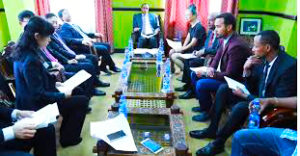
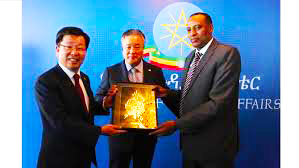

Permanent Secretary of Economic Diplomacy, Ambassador Dewano Kedir received a South Korean business from Busan city on Monday (December 17).
spokesperson, Meles Alem briefed the media regarding the results garnered since Ethiopia began allowing citizens of other African countries to
Prime Minister Dr. Abiy Ahmed met and held discussions with Addis-based European ambassadors this morning (December 14). According to Office
In response to Ethiopia being selected for the Millennium Challenge Corporation’s (MCC) threshold program, which assists countries to become eligible
WASHINGTON, D.C., December 12, 2018 – At its quarterly meeting, the U.S. Government’s Millennium Challenge Corporation (MCC) Board of Directors
Addis Ababa, December 11, 2018 – The Dire Dawa Industrial Park will be inaugurated next Sunday, December 16, 2018. The
Addis Ababa, December 12, 2018 – Ethiopia and Norway held the 2nd Political Consultation on today in Addis Ababa. The
State Minister of Foreign Affairs, Dr Markos Tekle met Mr Simon Mordue, Deputy Director- General of Migration and Home Affairs
Speaking at a forum on enhancing the evaluation capacity of the progress of implementation of SDGs and Agenda 2063 being
Prime Minister Dr. Abiy Ahmed met with Patrick Gaspard of the Open Society Foundations on Tuesday (December 11) here in
Addis Ababa December 09/2018 Prime Minister Abiy Ahmed and former United Kingdom Prime Minister, Tony Blair visited development projects in
Addis Ababa, December 7, 2018 – Prime Minister Dr Abiy Ahmed held discussions with Mr. Borge Brende, President of the

Permanent Secretary of Economic Diplomacy, Ambassador Dewano Kedir received a South Korean business from Busan city on Monday (December 17). Ambassador Dewano thanked the South Korean business delegation for choosing Ethiopia as its investment/business destination, and underlined that the economic cooperation between Ethiopia and South Korea will continue to embark on new horizons to strengthen and cement collaboration on investment promotion, trade and industrial parks development.
Heads of South Korean companies expressed their readiness to invest in Ethiopia in a range of areas, including Chemical Manufacturing, Construction, Assembling Industry, and pharmaceuticals.

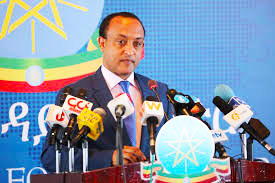
spokesperson, Meles Alem briefed the media regarding the results garnered since Ethiopia began allowing citizens of other African countries to enter the country by issuing visa on arrival. He said, “Ethiopia is taking the dream of free movement in Africa one step further. The number of our African brothers arriving to Ethiopia has increased dramatically and the visa on arrival arrangement is facilitating tourism, economic, regional integration & diplomatic relations.” He further said the decision to relax the visa regime will likely be a boon for the country’s hospitality and conference tourism sectors. The capital- Addis Ababa is one of the world’s largest diplomatic hubs, hosting the seat of the African Union, the United Nations Economic Commission for Africa, and dozens of foreign embassies. Meles stressed success has come since Ethiopia started issuing visa online for tourists and other visitors across the world. “This will make travel to Ethiopia easy, simultaneously boosting Ethiopian Airlines international presence steadily in recent years,” he added. The spokesperson further noted Ethiopia is currently undergoing significant political reforms; these political developments, among others; necessitated revisiting the existing nationality law that applies to foreign nationals of Ethiopian origin primarily aiming to reconnect and enable participation in their country’s affairs. He underscored the enhancement of Diaspora participation is playing a significant role in maintaining Ethiopia’s economic growth, conducive investment destination and tourist attraction. It is to be recalled that Prime Minister Dr. Abiy Ahmed and leaders of regional States have recently made frequent calls to the Ethiopian Diaspora, more than any time before, to create synergy and actively engage in the development of the country.

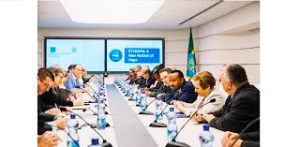
Prime Minister Dr. Abiy Ahmed met and held discussions with Addis-based
European ambassadors this morning (December 14).
According to Office of the Prime Minister-Ethiopia, the ambassadors welcomed
the progressive steps taken over the past months in Ethiopia under the new
leadership.
The ambassadors particularly commended the opening up of the political and
media spaces, and expressed their admiration regarding the role Ethiopia is
playing to bring stability and integration in the region.
Noting the positive changes taking shape, members of the European Union and
non-EU member countries equally confirmed their sustained partnership with
Ethiopia.

In response to Ethiopia being selected for the Millennium Challenge Corporation’s
(MCC) threshold program, which assists countries to become eligible for substantial
MCC financial support, Freedom House issued the following statement:
“The MCC’s new focus on Ethiopia is a well-deserved acknowledgement of the
progress Ethiopia has made in opening political space, advancing freedom of
expression and promoting peace in the Horn of Africa region,” said Jon Temin,
director of Africa Programs at Freedom House. “The government of Ethiopia should
take this acknowledgement and the potential support that comes with it as an
opportunity to press ahead with additional essential reforms. In particular, the
government should accelerate adoption of the civil society organizations
proclamation, strengthen the rule of law, and address the root causes of longstanding ethnic unrest. Critically, the government should reaffirm its commitment
to a free and fair election in 2020 by rolling out a comprehensive electoral roadmap
agreed upon by all major political actors.”

WASHINGTON, D.C., December 12, 2018 – At its quarterly meeting, the U.S.
Government’s Millennium Challenge Corporation (MCC) Board of Directors met to
select countries eligible for MCC assistance, which is designed to spur economic
growth and reduce poverty.
The Board selected Indonesia, Malawi and Kosovo for bilateral compacts – MCC’s
five-year grant program. The Board also selected Ethiopia and Solomon Islands for
MCC threshold programs – the agency’s smaller grant program focused on policy
and institutional reform.
This year, for the first time, MCC’s Board directed the agency to exercise its new
authority under the AGOA and MCA Modernization Act by selecting countries as
eligible to develop concurrent compacts for regional investments.
“I am pleased to announce new MCC compact partnerships with Indonesia, Malawi,
and Kosovo, and new threshold partnerships with Ethiopia and Solomon
Islands,” MCC Chief Operating Officer and Head of Agency Jonathan
Nash said. “The Board also directed MCC to explore regional investment
opportunities in five of its current compact partners in West Africa.”
MCC was created in 2004 as a new and different model of development assistance –
one focused on reducing poverty through economic growth. Built on the lessons of
decades of development experience, MCC provides time-limited grants to
developing countries that meet rigorous standards for good governance, from
fighting corruption to respecting democratic rights, as evaluated on MCC’s
scorecard. MCC takes a business-like approach, with bedrock commitments to data,
accountability, and evidence-based decisions. MCC’s investments are improving the
lives of millions of people around the world.
Indonesia
MCC’s Board selected Indonesia to develop a new compact in recognition of the
progress Indonesia has made in the fight against corruption, strengthening
democratic institutions, maintaining sound economic policies, and investing in its
people. Development assistance for Indonesia supports the Trump Administration’s
Indo-Pacific economic strategy and promotes peace, stability, and prosperity as well
as U.S. business engagement.
Malawi
MCC’s Board also selected Malawi to develop a new compact. Despite being the
third poorest country in the world, Malawi is one of the strongest performers on
MCC’s scorecard in the candidate pool.
Kosovo
MCC’s Board selected Kosovo to develop a new compact. Kosovo’s current MCC
threshold program will provide a solid foundation for a compact.
Ethiopia
MCC’s Board selected Ethiopia to develop a threshold program. The decision to
develop a threshold program underscores the Board’s recognition of the recent
reforms made by the Government of Ethiopia this year.
Solomon Islands
MCC’s Board selected Solomon Islands to develop a threshold program, which also
supports the Trump Administration’s Indo-Pacific economic strategy.
Concurrent Compacts for Regional Investments
The AGOA and MCA Modernization Act, signed by President Trump in April 2018,
authorizes MCC to enter into concurrent compacts to promote cross-border
economic integration, trade, and collaboration. The Board directed MCC to explore
regional investment opportunities in five of its current compact partners in West
Africa. The five countries selected as eligible are Benin, Burkina Faso, Côte d’Ivoire,
Ghana, and Niger. The Board decision allows MCC to work with each of the
countries to determine if there are projects that meet MCC’s strict investment
criteria as well as evaluate the countries’ ability to work with MCC and a partner
country on a regional investment. There is no guarantee a country selected as
eligible will be granted a concurrent compact.
MCC’s Board of Directors reselected Burkina Faso, Lesotho, Timor-Leste, and
Tunisia for continued compact development and The Gambia for continued
threshold program development. The Board reviewed policy performance for all
country partners in compact and threshold development.

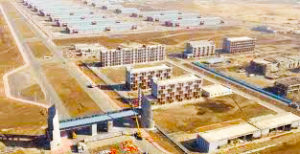
Addis Ababa, December 11, 2018 – The Dire Dawa Industrial Park will be
inaugurated next Sunday, December 16, 2018.
The park, located in the eastern Ethiopia approximately 262 km from Djibouti, will
be inaugurated in the presence of senior government officials, including Prime
Minister Dr Abiy Ahmed.
Other invited guests from abroad are also expected to attend the event, according
to the Ethiopian Industrial Parks Development Corporation.
The Jimma industrial park was inaugurated last Saturday in the presence of the
Prime Minister as well as Presidents of Sudan and Djibouti, al-Bashir and Omar
Guelleh, respectively.
Ethiopia has built several industrial parks to attract investment.

Addis Ababa, December 12, 2018 – Ethiopia and Norway held the 2nd Political
Consultation on today in Addis Ababa.
The Consultation is aimed at further enhancing mutual understanding and
strengthening of the historical relations and bilateral cooperation between the two
countries.
Director-General of European Affairs at the Ministry, Ambassador Tesfaye Yilma
noted the importance of expanding the bilateral cooperation across a wide spectrum
of areas, including the need to deepen political consultation, enhance trade and
investment ties, and boost the partnership on climate change as well as work
together on UNSC platforms.
Director-General of Regional Department at the Norwegian Ministry of Foreign
affairs, Ms. Tine Morch Smith commended the recent peaceful transition of power in
Ethiopia that laid the foundations for a durable constitution order that would chart
the country’s political, economic and social demands.
She noted the rapprochement between Ethiopia and Eritrea and its peace dividends
to the region, Ms. Morch said, “Ethiopia continues to be the anchor of peace and
stability in the region”.
Ethiopia and Norway have common interests in many areas as demonstrated by a
number of high-level official visits, including visits by Crown Prince of Norway His
Royal Highness Haakon to Ethiopia in November 2017 and Foreign Minister Dr.
Workneh Gebeyehu’s visit to Norway in June 2018.
In 2012, Ethiopia and Norway agreed to scale up their political and diplomatic
relations by signing a MoU on political, social, educational, development
cooperation.
Diplomatic relations between Ethiopia and Norway was established in 1947,
according to the Ministry of Foreign Affairs.

State Minister of Foreign Affairs, Dr Markos Tekle met Mr Simon Mordue, Deputy
Director- General of Migration and Home Affairs of the European commission on the
margins of the Intergovernmental Conference to adopt the Global Compact of
Migration in Marrakesh, Morocco. On the occasion, Dr Markos discussed the
sweeping changes Ethiopia is undergoing in introducing political and economic
reforms. He underlined that the changes in Ethiopia are positively impacting the
region towards peace and stability and regional integration. He in particular
highlighted that the peace accord between #Ethiopia and Eritrea has created
immense optimism in changing the conflict trap the sub-region finds itself in the
past few decades. On migration, Dr Markos underlined that focus should be given to
creating economic opportunities at home to prevent the youth from falling prey to
traffickers. He further elaborated the efforts Ethiopia is making in job creation
through labour intensive light manufacturing by building industrial zones in different
parts of the country.
He urged the #EU to further intensify its support to Ethiopia in job creation and
return as well as reintegration of returnees. He expressed his appreciation with the
EU on the progress made with the Jobs Compact and affirmed Ethiopia’s readiness
to further build on the achievements made so far.
Mr. Simon expressed his appreciation to the democratic reforms in Ethiopia and
affirmed EU’s support. He in particular noted EU’s desire to collaborate with Ethiopia
in return and reintegration, and fighting human trafficking. He also indicated EU’s
plan to pilot circulation migration where citizens from origin countries will be
allowed to European countries and return home after working for a defined period
of time.
He further reaffirmed that the EU will support Ethiopia in realizing the commitment
contained in the Global Compact on Migration.

Speaking at a forum on enhancing the evaluation capacity of the progress of
implementation of SDGs and Agenda 2063 being held in Addis Ababa (December
10-12), UNICEF’s Director of Evaluation, George Laryea-Adjei said “Ethiopia
continues to champion the sustainable development of Africa at UNICEF and the
whole UN”.
A high-level Ethiopian delegation led by Getachew Adem, State Minister of National
Planning Commission is taking part in the two-day forum, which aimed at
enhancing national evaluation capacities of member states of the African Union.
State Minister Getachew Adem noted the importance of evidence-based Voluntary
National Reviews (VNRs), which he said, included country-led evaluations.
The State Minister said SDGs and Agenda 2063 and the modalities of the review
instruments are aligned with Ethiopia’s national policies and development
framework.
He mentioned that Ethiopia had already submitted its VNR in 2017, adding that the
country has received positive feedback in such score.
The forum was organized by UNICEF in collaboration with the Permanent Mission
of #Ethiopia to the United Nations and the African Union and UNECA .

Prime Minister Dr. Abiy Ahmed met with Patrick Gaspard of the Open Society
Foundations on Tuesday (December 11) here in Addis Ababa. According to
the Office of the Prime Minister-Ethiopia , discussions focused on the progress of
reforms currently taking place in Ethiopia.
On the occasion, Mr. Gaspard expressed his admiration of the developments
underway and vowed the commitment of the Open Society Foundations to
support Ethiopia fulfill its democratization objectives, particularly in the areas of
justice sector reform and strengthening of institutions.
The Open Society Foundations is an international grant-making network which aims
to build vibrant and tolerant democracies whose governments are accountable and
open to the participation of all people.

Addis Ababa December 09/2018 Prime Minister Abiy Ahmed and former United
Kingdom Prime Minister, Tony Blair visited development projects in Bale.
Senior government officials and international development partners have
accompanied the visit to the development projects in the south eastern part of
Ethiopia.
The former UK’s Prime Minister Tony Blair has been a close ally of Africa in
general and for Ethiopia in particular in pushing the continent’s problems up the
global political agenda beyond his development assistance to Africa.
After leaving office, he has established the Tony Blair Institute for Global Change
to work on some of the most difficult challenges in the world today, including
how the centre ground of politics renews itself with practical policy solutions.
His Institute for Global Change is a not-for-profit organization dedicated to
making globalization work for the many, not the few.
It also works to provide policy and strategy in support of a vision of globalization
designed to improve the well-being of the people, economically, politically, and
socially.
The institutions is working in partnership with the government of Ethiopia to
achieve its development agendas through strengthening the administration’s
programme management, analysis and coordination capabilities and accelerate
progress in areas like private sector development.
This includes supporting the government to create two million manufacturing
jobs in 10 industrial parks across the country and enhancing the institutions
critical for their vision for industrialization.

Addis Ababa, December 7, 2018 – Prime Minister Dr Abiy Ahmed held
discussions with Mr. Borge Brende, President of the World Economic Forum
(WEF) in his office today.
During the discussions, Mr. Brende stated that the World Economic Forum
recognizes and appreciates the ongoing political and economic reforms in
Ethiopia, according to Office of the Prime Minister.
He also officially invited the Prime Minister to attend the upcoming World
Economic Forum scheduled to take place in Davos, Switzerland in January,
2019.
Brende also met with Ethiopia’s Minister of Foreign Affairs, Dr. Workneh
Gebeyehu.
Dr.Workneh briefed Brende on the sweeping reforms happening in the country
as well as the recent developments in the Horn.
He said “now the Horn is the hope of the entire Africa”.
On aspects of regional issues, the Minister noted the current stability in South
Sudan.
He also called on the international community to support the institutionalization
process in Somalia.